Lesson 14 · 15 min
Practising well
Slow practice, small chunks and loops, hands separately, stopping or playing through, short daily sessions, learning by heart, playing for others and playing without strain.
In the app the figures sound and answer to your keyboard, and the exercises check what you play.
Practising is not playing a piece over and over. It is finding what does not work yet and making it work, a little at a time, so that next time it is easier. A few habits make the same minutes go much further.
Slowly
Your hands learn what they repeat, mistakes included. Play a passage too fast and stumble, and you are practising the stumble. Play it slowly enough to get every note, every finger and every rhythm right, and that is what they learn.
So start at a tempo where you can play it without mistakes, however slow that is. Play it right a few times running, then go up a small step. If it falls apart, step back down. It feels slow, but it is the quickest way there.
60%: ♩ = 60Play it cleanly three times running before you take the next step.
- 60%: ♩ = 60
- 70%: ♩ = 70
- 80%: ♩ = 80
- 90%: ♩ = 90
- 100%: ♩ = 100
The Metronome climbs the ladder for you: its tempo trainer can speed up from one tempo to another, a few beats per minute every few bars. Its silent bars leave the click out now and then, so you keep the beat yourself. In the Pieces, the tempo can be set to a share of the score’s, and in wait mode the score waits for each note, however long you take.
A little at a time
Work on a bar or two at a time, not the whole page. Play the chunk and the first note of the next bar, so the join is practised too. Once two chunks are secure, join them, then join the pair to the next.
In the Pieces, a loop plays the same bars again and again: set where it starts and ends. After a few runs, the weak bars show where you slow down or miss notes, and can loop the weakest for you.
Hands separately, then together
Learn each hand alone until it is easy, then put them together, slowly, a few bars at a time. Playing together is a skill of its own, so it needs a slower tempo than either hand alone. Give more time to the hand that finds it harder; for most people, that is the left. The Pieces let you practise the right hand, the left or both.
Stopping, and going on
There are two ways to practise a piece, and you need both.
- Stop and fix. At a mistake, stop. Find out what went wrong (a note, a finger, the rhythm), play that spot slowly and right several times, then play it again with a bar either side. This is how a piece is learnt, and most of your time goes here.
- Play through. Play from start to end without stopping, whatever happens, as you would for a listener. This is how you find out what is secure, and learn to keep going.
Use the first while you learn a piece, and the second once near the end of a session, and more often as a performance comes closer. In the Pieces, wait mode is for stopping and fixing: it waits for the right notes. Rhythm mode is for playing through: the score moves on in time, and every note is timed.
The hard bar first
If you always start at the beginning, the first page gets played a hundred times and the last hardly at all. Start with the hardest passage, while you are fresh. Start from different places: the middle, the last line, the start of each section. The end of a piece should be the part you know best.
Short, spaced and daily
A little every day beats a lot now and then. Your hands and your brain go on learning between sessions, especially while you sleep, so twenty focused minutes a day do more than two hours on a Sunday. Focused is the word: twenty minutes on a hard bar do more than an hour of playing through what you already know.
Plan the session before you sit down, with the hardest work early. Split a long session with short breaks. The Progress page counts the days you practise in a row, the streak, and the minutes towards a daily goal.
- 3 minWarm up: a scale or two, slowly and evenly.
- 8 minThe hard spots: a bar or two at a time, slowly, in a loop, then a little faster.
- 3 minSomething new: the next lines of a new piece, or some reading or ear training.
- 4 minPlay through: a piece from start to end without stopping, as if someone were listening.
- 2 minFor fun: something you already love to play.
Learning by heart
The fingers learn a piece by themselves if you play it often enough. But the fingers’ memory is the first to go when you are nervous, and then there is nothing to fall back on. A piece learnt by heart safely is known in several ways at once:
- By ear: you can sing the tune and hear what comes next.
- By its harmony and form: you know the chord of each bar, and which phrases come back.
- By its shape: where the hands go on the keyboard, the patterns under the fingers.
- By each hand alone: you can play either hand without the other.
A plan for learning a piece by heart, a few bars a day:
- Listen to it, and sing the tune.
- Name the chords and mark the sections: where each phrase begins, and what repeats.
- Learn a phrase with the music, hands separately, then together.
- Play it without looking, each hand alone, then together. Look only when stuck.
- Choose landmarks: the start of each phrase and section. Practise starting from each of them, in any order.
- Away from the piano, play it in your head, and see the hands move.
- The next day, play it from memory before you look at the page again.
Playing for others
Everyone is nervous playing for others; a racing heart and cold hands are normal. It gets easier with practice, so practise it too.
- Play for someone: a friend, your family, a call on the phone. Tell them you are practising a performance, and play it through.
- Record yourself on your phone and listen back later. You hear things you cannot hear while playing: a hurried bar, a tune lost under the chords.
- Have a routine before you begin: set the bench, rest your hands on your knees, breathe out slowly, hear the first bar in your head at its tempo, then start.
- After a slip, keep going. Listeners rarely notice a wrong note, but everyone hears a stop. Come in again on the next beat, or at the next landmark.
Playing without strain
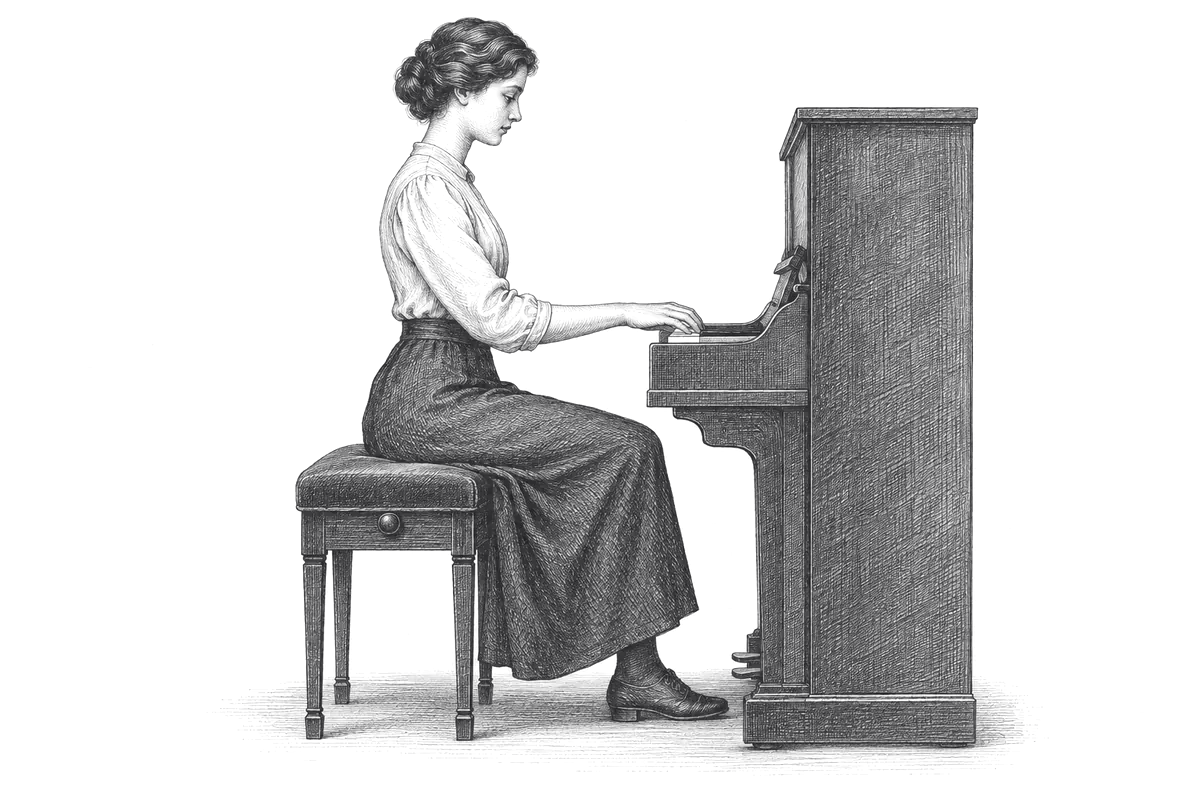
The piano should never hurt. Keep your shoulders low and loose, your wrist free, and let the weight of the arm play the keys rather than squeezing them. Once a note has sounded, stop pressing: the key only needs to be held, not pushed.
- Take a short break every twenty or thirty minutes: stand, shake out your hands.
- Pain is a signal to stop, not to push through. Rest, play more gently, and if it comes back, ask a teacher or a doctor.
- Hands come in all sizes. Never force a stretch: spread a chord that is too wide, leave out a note that is not the tune or the bass, or share it with the other hand.
What an app cannot hear
dacapo hears which keys you play, when, and with a MIDI keyboard how hard. That is a lot, but it is not everything. It cannot hear your tone, the sound in the room, or whether a phrase sings. It cannot see your arm, your wrist or your shoulders, and a habit of tension is easier to prevent than to cure.
A teacher hears and sees all that. Even a few lessons now and then, to check how you sit, how you move and how you sound, are worth it; use the app for the practice in between.
Try it
A few questions on the ideas of this lesson.
This exercise is played in the app.
Then take a piece in the Pieces, find its hardest bars, and loop them slowly, one rung of the ladder at a time.