Beyond the lessons · 8 min
Inside the piano
What happens between your finger and the string: the hammer, the jack that lets it fly, the damper, and why only the speed of your press counts.
In the app the figures sound and answer to your keyboard, and the exercises check what you play.
A piano is a machine for throwing a small felt hammer at a string, and catching it again. Between your finger and the string, every key has its own small machine, the action: wooden levers, felt, cloth and springs, adjusted to fractions of a millimetre. Play a key here or on your own keyboard, and watch it work.
One key, in slow motion
This is one key of a grand piano cut in half, as if seen from the side, with you sitting on the left. Press any key and the drawing plays it at the speed you pressed. Real speed is too fast to follow, so it starts four times slower. Only the drawing slows down: you hear the note at once, before the hammer gets there on the page.
- Key
- a lever on the balance rail: press the front down, and the back end rises.
- Capstan
- a small screw on the key that lifts the wippen. Turning it sets how soon the action answers.
- Wippen
- a lever that passes the key’s movement on to the jack and the repetition lever.
- Jack
- pushes the hammer up by its knuckle, then tips out from under it just before the hammer reaches the string.
- Let-off button
- when the jack’s toe meets it, the jack tips away: the hammer is let go two or three millimetres below the string.
- Repetition lever
- a sprung lever that holds the hammer up while the key rises a little, so the jack can slip back under it and the note can be played again at once.
- Hammer
- hard felt on a wooden shank. It flies to the string on its own and bounces straight off, so the string can ring.
- Backcheck
- catches the falling hammer by its tail while the key is held, so it cannot bounce back into the string.
- Damper
- a felt pad resting on the string. The key lifts it as you play; when you let go, it falls back and stops the sound.
- String
- steel wire pulled very tight. Together, a grand piano’s strings pull with a force of around twenty tonnes.
- Soundboard
- the string’s vibration passes through the bridge into a wide, thin wooden soundboard, which makes it loud enough to fill a room.
- The key goes down. The capstan lifts the wippen, and the jack lifts the hammer.
- Let-off: the jack’s toe meets its button and the jack tips out. The hammer flies on alone.
- The hammer strikes the string and bounces straight back off it.
- The backcheck catches the hammer. The damper is up: the string rings as long as you hold the key.
- Let the key up a little: the repetition lever lifts the hammer, the jack slips back under it, and the note can be played again.
- Let go: the hammer returns, the damper falls onto the string, and the sound stops.
The hammer flies free
The surprising thing about a piano is that you never push the hammer into the string. Just before it gets there, the jack tips out from under it (this is the escapement), and the hammer travels the last few millimetres on its own. It bounces straight off, and that is what lets the string ring.
So once the hammer is on its way, nothing you do can change the note. Pressing harder into the bottom of the key does nothing at all. What makes a note louder is only how fast the hammer is thrown, that is, how quickly you press the key. Try it above: with a MIDI keyboard, press slowly, then quickly, and watch the loudness. The computer keys and a click always press at the same speed, so choose Soft or Loud instead.
Dampers and pedals
Every key but the highest ones has a damper. The key lifts it as you play and lets it fall when you let go, so a note lasts exactly as long as you hold it.
- The right pedal, the sustain pedal, lifts every damper at once: notes ring on after you let go, and other strings ring along with them. Switch it on above and let go of a key.
- The left pedal, the soft pedal, slides a grand’s whole action a little sideways, so each hammer strikes fewer of its strings: most notes have three. The sound is softer and less bright.
- The middle pedal, on most grands, holds up only the dampers that are already up, so a chord can ring while the next notes stay short.
A whole octave, keys to soundboard
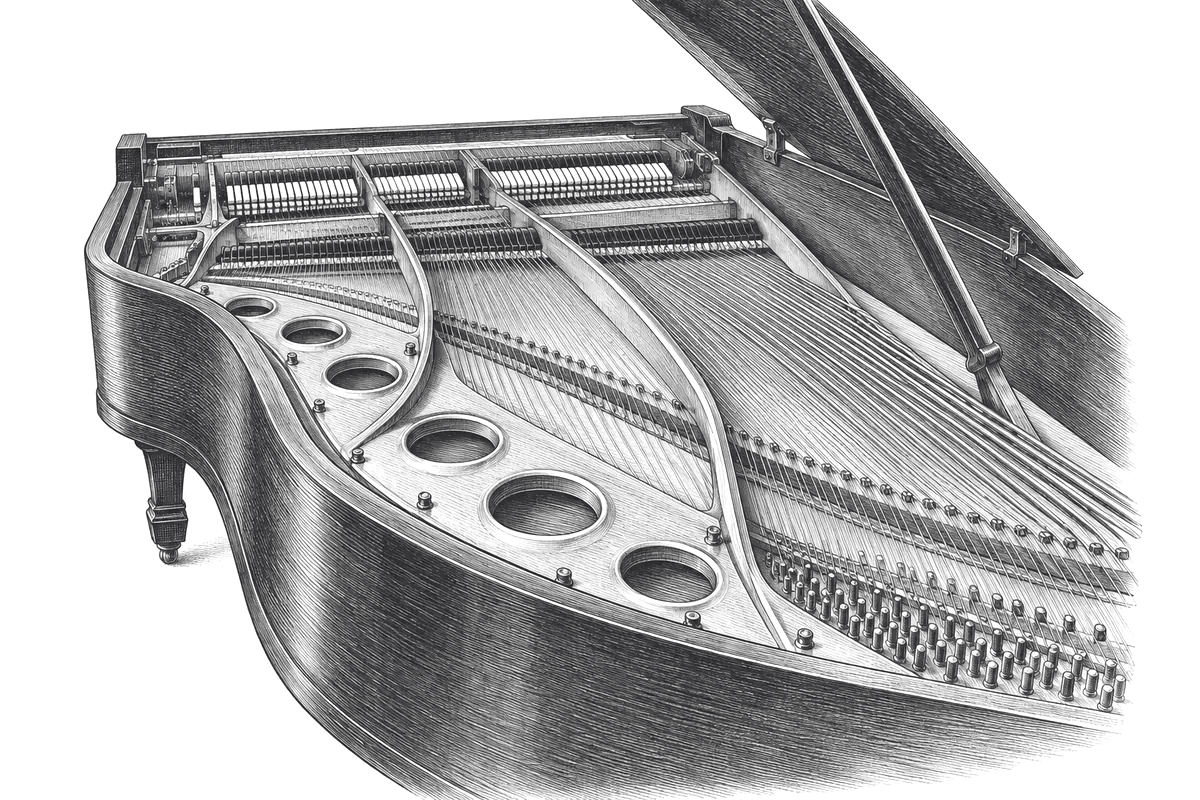
Here is one octave of a grand, C4 to B4, cut open and at its true size: twelve keys and their actions, and over them the cast-iron frame with its tuning pins. Each note has three steel strings, each pulled to about 70 kilograms. They run from the pins through brass agraffes, under the dampers and over the bridge, a curved strip of wood glued to the soundboard, to hitch pins at the back. A string on its own is barely heard: it is the bridge and the thin spruce board under it that move enough air.
Each string is as long as its note needs: 380 mm for A4, and nearly twice that an octave lower, which is why the bridge curves. The three pedals are under the keys; try each one.

Grand and upright
In an upright piano the strings stand on end, so the hammers strike forwards instead of up, and springs, not their weight, bring them back. Its action has no repetition lever like this one: a note can be played again only once the key has come most of the way up. The grand’s double escapement, patented by Sébastien Érard in 1821, lets a pianist repeat a note from a key only part way up, which is why fast repeated notes are easier on a grand.
Test yourself
This exercise is played in the app.